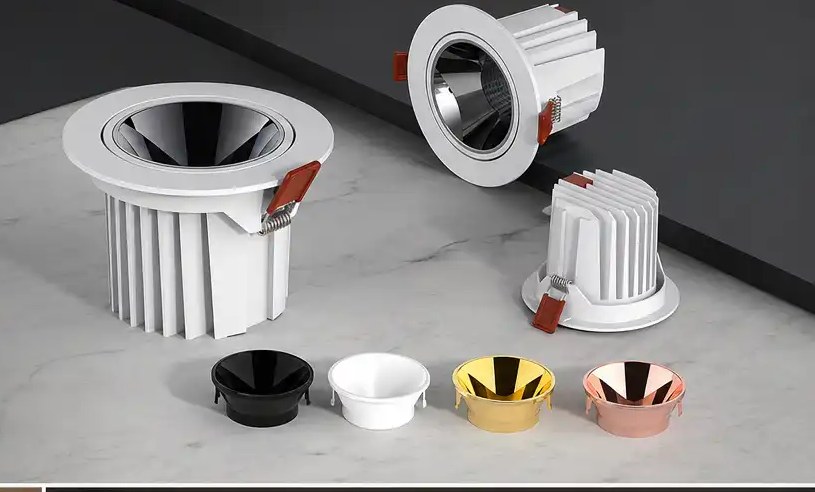
You're up a ladder, second visit to the same job. The first batch of downlights went in last week. The client stands below with a hand shading her eyes, saying the kitchen lights feel like a dentist's chair. You look up. There it is — a bare bright chip staring straight back at you from a shallow trim. That's usually the moment people start hunting for anti-glare downlights.
We build these things. So this comes from the bench, not a showroom floor. There's no single number on our side that guarantees comfort. Anyone who says otherwise is selling you something.
What glare actually is, in plain terms
Glare happens when one part of what you're looking at is way brighter than everything around it. Your eye settles into the overall scene. Then a small hot source yanks against that settling. You feel it as squinting. A dull ache behind the eyes by mid-afternoon.
Two kinds, broadly. Disability glare actually kills what you can see — oncoming headlights at night are the classic case. Discomfort glare doesn't blind you, it just wears you down. Indoors, discomfort is what people complain about, and it's the one a downlight's design can do something about.
A downlight turns into a glare source the moment you can see the bright LED itself, or a bright reflection of it, from wherever you happen to be sitting or walking. That's it. That's the whole problem. Control what the eye can see from the angles people actually occupy, and you've solved most of it.
UGR is a room number, not a fitting number
UGR — Unified Glare Rating — is how most specifiers talk about discomfort glare indoors. Worth knowing what it actually measures, because people quote it like it's a property stamped on the lamp.
It isn't. Not really. UGR gets calculated for a viewer standing in a room. It factors in how bright each luminaire looks from that viewpoint, how big it appears, where it sits in the field of view, and how bright the background is. Move the room, the number moves. Same light, different result.
So a darker ceiling changes things. A lower mounting height changes things. A different layout, a different viewing direction — all of it shifts the outcome. A manufacturer can publish a figure for a standard reference room, and that's useful for comparing products side by side. It is not a promise about your café or your boardroom. That's why we don't slap headline glare numbers on product pages. If a project needs a figure, it comes from a photometric file and a calculation for the real space.
The Illuminating Engineering Society publishes design guidance on visual comfort, and photometric test methods live in international standards from the IEC. Go there for formal definitions. What follows is the physical side — what a factory can actually change.
The levers inside the can
Comfort comes from geometry and optics. Not a coating. Not a label. Three levers do most of the work, and they fight each other constantly.
Reflector depth, and how far back the source sits
Push the LED further back inside the fitting and it drops out of view sooner as you step away from directly underneath. A deep reflector, or a recessed source, means that from most normal viewing angles you see a softly lit cone instead of the chip. That's why a lot of anti-glare designs look like a dark hole with a bright floor beneath it.
The catch is space. A deeper optic usually means a taller body. Glare control and ceiling depth pull against each other, and you can't have both for free. If the void is shallow, check the body height on the sheet before you fall for a deep-cone design. Our cut-out size guide walks through how to check that depth.
Shielding
Shielding is anything that physically blocks the straight line from source to eye. A recessed baffle. A honeycomb louvre. A ribbed or black inner cone. Black and textured baffles cut down stray reflections bouncing around inside the fitting, so the trim itself doesn't glow. The angle at which the source is fully hidden is often called the cut-off angle, and the bigger it is, the more of the room gets shielded.
Diffusers work differently. A frosted or opal cover spreads the brightness over a larger area, which lowers peak luminance — but it can also make the whole face glow. Whether that's better depends on the space.
Beam spread
A narrow beam puts light where you want it and keeps less of it heading toward eye level. A wide beam fills a room evenly but throws more light out at shallow angles, which is exactly the direction people look from. Neither is right in general. A gallery wall wants control. A classroom wants evenness, and gets its comfort from shielding instead.
COB sources suit deep reflectors because they act as one compact source the optic can shape. SMD boards spread the LEDs out, which usually pairs with a diffuser. We compare the two on the LED downlights page, family by family.
Sheet in hand? Here's how I'd read it
The natural question at this point sounds like: "which line on the datasheet tells me if it's going to be uncomfortable?" Truth is, no single line does. You read the whole sheet together, drawing open beside it.
| Field | What it tells you about glare |
|---|---|
| Light source (F5) | COB or SMD, which hints at the optical approach: reflector or diffuser. |
| Body height (F3) | A deeper body often means a deeper, better-shielded optic. It also has to fit your void. |
| Beam description | Whether the model is built for accent or general light. Confirm the beam option per model. |
| Power (F4) | More output from the same aperture raises brightness at the face. Match it to the task, not to the biggest figure. |
| CCT (F6) and CRI (F7) | Not glare fields, but they change how a bright source feels. Keep them consistent across one space. |
| Dimming (F8) | The ability to bring levels down is a practical comfort tool in rooms used at night. |
Look at the drawing too, not just the table. A section through the fitting shows how far back the source sits and what the baffle looks like. That one image tells you more about comfort than most marketing lines ever will.
What we'd ask the factory, if we were you
Picture a small hotel corridor refit. Low void, painted plaster ceiling, no room for a deep can, and the owner keeps saying "nice warm light, no glare." The half-deep fitting on the sample board looks fine in the office and looks terrible at three in the morning when a guest opens the door. That's the conversation you want to have before the order, not after. So don't ask whether a model is "anti-glare." Every supplier says yes. Ask things that need a real answer. A photometric file for this exact model and beam option — and which test standard it was measured to. How far the source is recessed, and whether the inner cone or baffle is black, textured or reflective. Which beam options exist for this body, and whether the optic changes with them. Whether the glare figure they quote comes from a calculation for a reference room, and whether they'll share the assumptions. What happens to body height if you pick the deeper optic. Answers like those let a lighting designer run the calculation for the actual room. Vague answers are a signal too. You'll notice the difference fast.
Where it bites hardest
Some spaces punish glare harder than others. Offices and classrooms, where people look up from screens and boards for hours on end. Hotel rooms and corridors, where guests lie down and stare straight at the ceiling. Restaurants, where a bright spot over a table is the first thing a diner notices. Shops, where you want people looking at the shelves, not squinting at the lights.
In homes it's often the living room and bedroom that suffer, because downlights get dotted in a grid without anyone thinking about where people actually sit. The applications page lays out which families tend to fit which rooms.
Smart control can soften a bright room at night too, though it won't fix bad optics. That side is covered in our smart WiFi downlights checklist — confirm smart functions with our team before you spec them.
The bench rule
Glare is contrast the eye can't settle. UGR describes it for a viewer in a room, so treat any published figure as a comparison tool, not a guarantee. Inside the fitting, recess, shielding and beam do the work — and they cost you depth. Read the sheet with the drawing open. Ask for photometric data. Size the optic to the room you've actually got, not the one in the brochure.
Still up that ladder? Measure the void before you order.