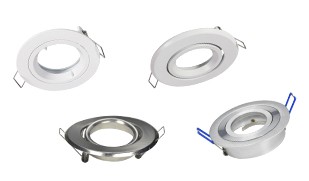
Fittings · lamp separate
GU10 / MR16 frames & housings
Frames and housings for GU10 or MR16 lamps in aluminium, iron and plastic lines, sold as fittings and kept apart from complete lights.
Housings & frames →Sampo Lighting makes LED downlights in five families (GU10/MR16 frames and housings, COB, SMD integrated and panel, E27, and smart WiFi) and sets out every model as a spec sheet you can check against your ceiling before you order.
Cut-out, face diameter, body height, power, colour temperature and CRI belong to a model, not to a family, so we don’t print them as headline numbers. This page shows where each family’s boundaries sit and which fields to confirm. The spec sheet for your model supplies the values.
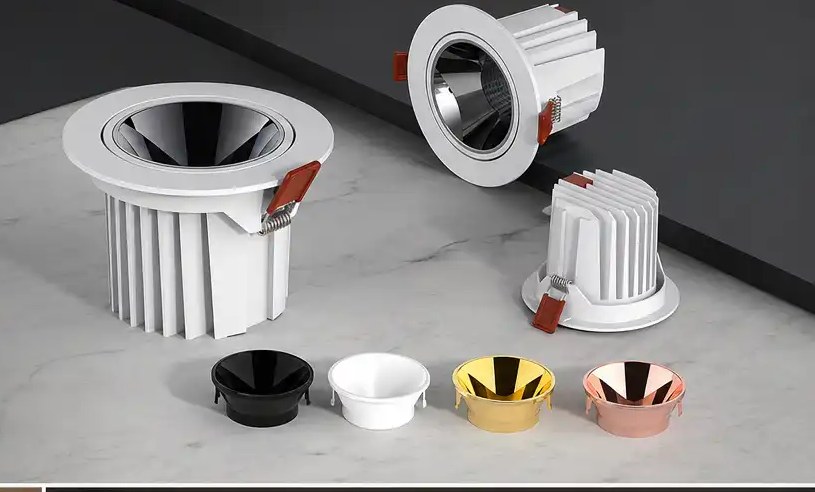
Read across a row before you read a catalogue. Each row tells you what the body is made of, how it mounts, what actually decides the cut-out, and which F-codes to confirm. The last column holds no numbers on purpose: values live on the model’s spec sheet.
| Family | Body / housing construction | Mounting | What decides the cut-out | Confirm before ordering | Per-model values |
|---|---|---|---|---|---|
| GU10 / MR16 frames & housingsFittings | Frame or housing that holds a separate GU10 or MR16 lamp. Housing lines in aluminium, iron and plastic. | Frame fixes into the ceiling opening; fixing method per model (F11). | The housing’s outer body, not the lamp. | F1 · F2 · F3 · F10 · F11 · F12 | per-model — confirm on spec sheet |
| COB downlightsComplete light | COB source behind a reflector. Twin-head recessed, adjustable-angle and anti-glare versions. | Recessed or surface, per model (F11). | The body and reflector of the specific model; twin-head fittings take a rectangular opening. | F1–F12 | per-model — confirm on spec sheet |
| SMD integrated & panel downlightsComplete light | SMD LEDs on a board behind a diffuser, in integrated and panel bodies. | Recessed or surface, per model (F11). | The panel or body outline of the specific model. | F1–F12 | per-model — confirm on spec sheet |
| E27 downlights & bodiesBody + separate lamp | Downlight body built around an E27 lamp holder; the lamp is its own order line. | Recessed or surface, per model (F11). | The body diameter; lamp choice changes the depth needed (F3). | F1 · F2 · F3 · F10 · F11 · F12 | per-model — confirm on spec sheet |
| Smart WiFi downlightsComplete light · networked | Networked complete light with app control, dimming and CCT adjustment on selected models. | Same as non-smart: recessed or surface, per model (F11). | The body of the specific model, by the same rule as a non-smart downlight. | F1–F12 + app / gateway / voice-platform check | per-model — confirm on spec sheet |
Each card leads to the page holding the full boundary notes for that family.
Frames and housings for GU10 or MR16 lamps in aluminium, iron and plastic lines, sold as fittings and kept apart from complete lights.
Housings & frames →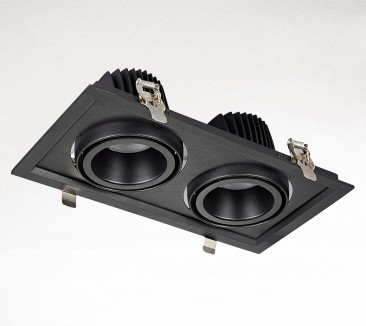
A single COB source behind a reflector, including twin-head recessed, adjustable-angle and anti-glare versions.
COB family notes →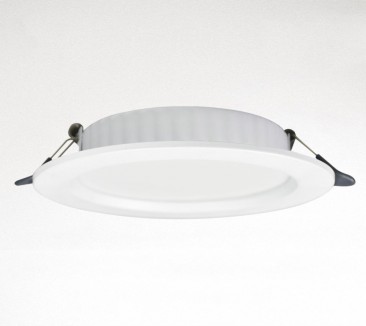
SMD LEDs spread behind a diffuser for an even, flat lit face, in integrated and panel bodies.
SMD family notes →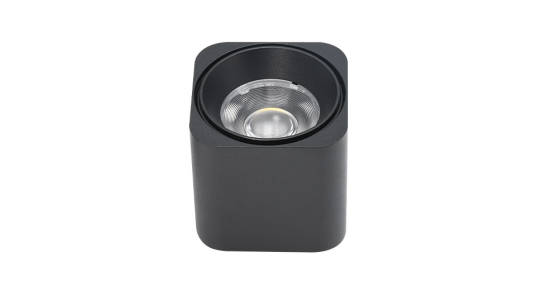
Downlight bodies with an E27 lamp holder, so the end user can change the lamp; the body is the product.
E27 family notes →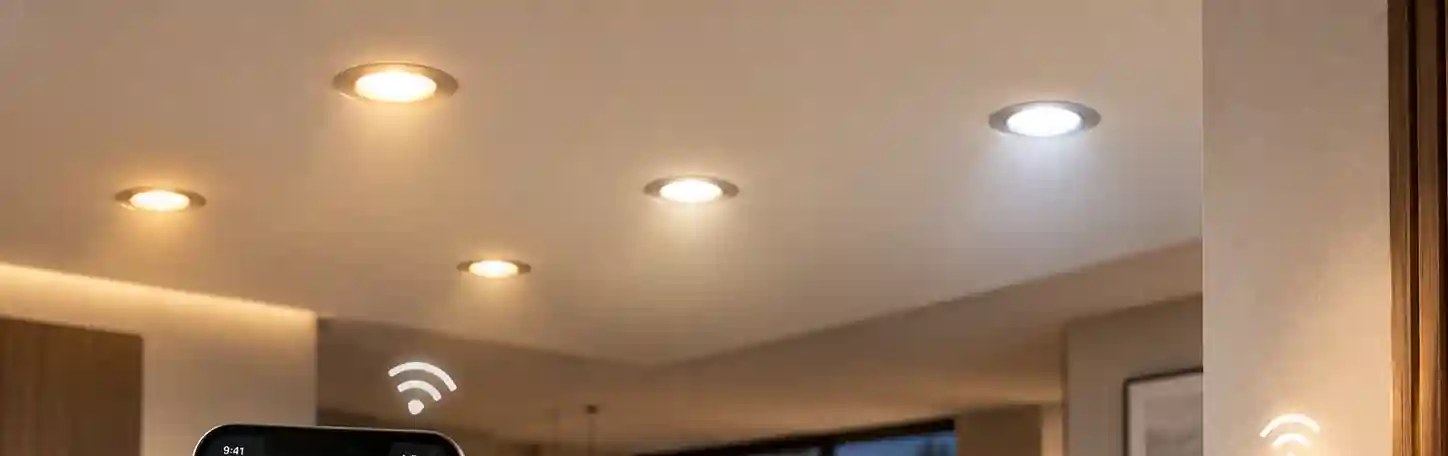
App control, dimming and CCT adjustment on selected models; compatibility is confirmed with our team, model by model.
Smart WiFi checks →On a retrofit, measure the opening itself, not the old trim, and in more than one direction. On a new build there’s no hole yet, so the model’s F1 becomes the cutting instruction.
Find the row in the boundary table. A GU10 frame, a COB body and a flat SMD panel can share a ceiling yet have their hole set by different parts of the fitting.
Send the hole size with the F-codes that matter on your job, usually F1, F2, F3 and F11, plus F4 to F9 for complete lights. We answer from the exact model’s spec sheet.
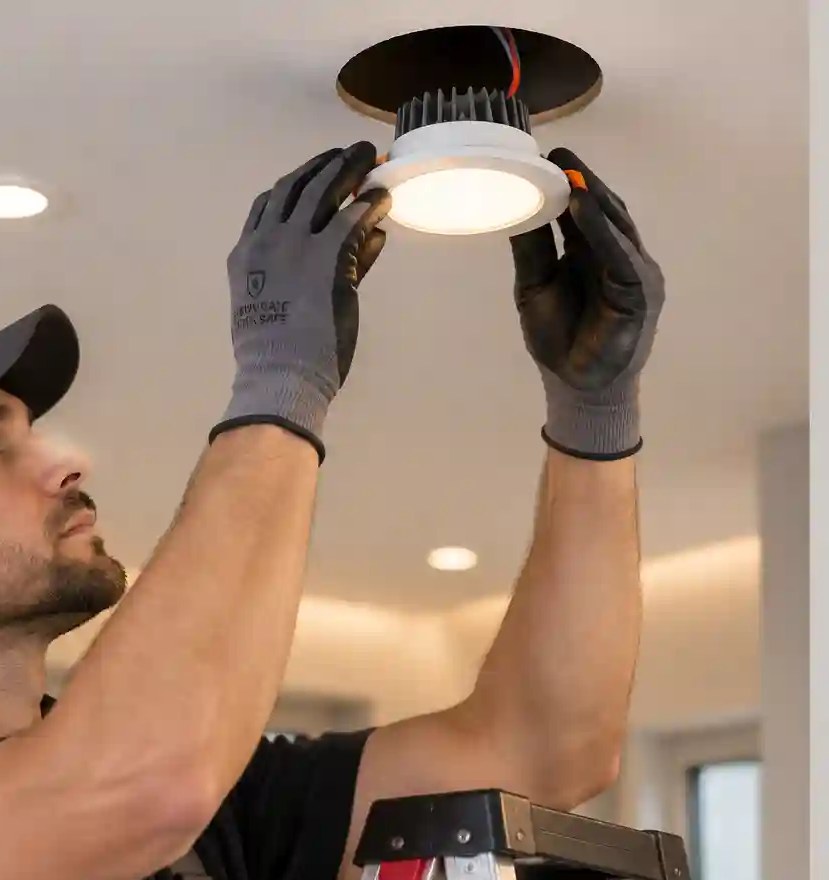
Twelve fields cover whether a downlight fits, whether it lights the space the way the drawing intends, and how it’s covered afterwards. Quote the codes in an enquiry (“confirm F1, F3 and F8 for this model”) and the answer comes back field by field.
| Code | Field | Why it matters | Value for your model |
|---|---|---|---|
| F1 | Cut-out size | The hole in the ceiling. On a retrofit it has to match the hole that’s already there; on a new build the hole is cut to this figure. Check shape as well as size. | per-model — confirm on spec sheet |
| F2 | Face diameter | The visible trim. It has to overlap the cut edge, so it’s always a different figure from F1. Never read one as the other. | per-model — confirm on spec sheet |
| F3 | Body height | Depth above the ceiling line, including anything attached to the body. It has to clear joists, ducts, pipes and insulation in the void. | per-model — confirm on spec sheet |
| F4 | Power | Sets driver choice and circuit loading. Quote it per model; a family name alone doesn’t fix it. | per-model — confirm on spec sheet |
| F5 | Light source: COB or SMD | COB gives one concentrated source behind a reflector; SMD spreads LEDs across a board. It changes the lit face and the glare control. | per-model — confirm on spec sheet |
| F6 | CCT range | Colour temperature on offer for the model, fixed or selectable. Match it across every fitting in one space. | per-model — confirm on spec sheet |
| F7 | CRI | Colour rendering. It matters most where people judge colour: shops, restaurants, galleries, hotel rooms. | per-model — confirm on spec sheet |
| F8 | Dimmable or not | Whether the model dims, and by which method. It has to suit the dimmer or control system on site. | per-model — confirm on spec sheet |
| F9 | CCT-adjustable or not | Whether colour temperature can be changed after installation, and how it’s switched. | per-model — confirm on spec sheet |
| F10 | Housing material | Aluminium, iron or plastic. Affects weight, finish and how heat leaves the body. | per-model — confirm on spec sheet |
| F11 | Mounting | Recessed or surface, plus the fixing method. Surface models need no cut-out, so F1 drops out of the check. | per-model — confirm on spec sheet |
| F12 | Warranty | Varies by model. Take the term from the spec sheet of each model on the order, never from a family. | per-model — confirm on spec sheet |
Certifications: per model, check the spec sheet.
GU10 and MR16 frames and housings in aluminium, iron and plastic lines. The housing sets the cut-out, the trim and the fixing; the lamp is a separate item with its own spec.
COB, SMD integrated and panel, and smart WiFi downlights arrive with the light source in the body. One spec sheet covers optics, power and colour fields together.
E27 downlights and bodies sit between the two: the body is the product and the lamp is chosen separately, so treat the lamp as its own line and check body depth (F3) with that lamp in mind.
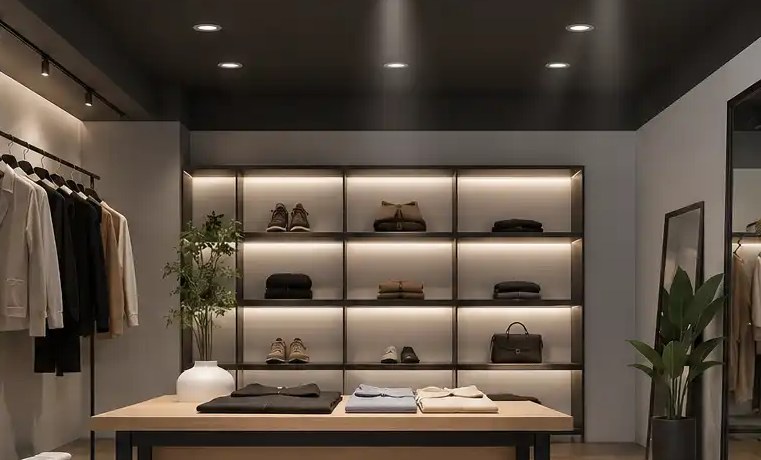
A shop wants light on merchandise and good colour rendering; a living room wants comfort and dimming; a corridor wants even light and nothing more. The families don’t change between them. What changes is which F-fields you check hardest and which version of a family you pick.
Downlights are the core of this site. Sampo Lighting also builds magnetic systems, track heads and conventional rails, nineteen series in all with the downlights included. They’re listed on one page as display cards with a single factual line each, and any of them can be added to the same enquiry.
Private-label and custom downlights start from the same F-field list. You mark which fields your design fixes and which you want us to propose; our R&D team turns that into drawings, then samples, before anything goes into production. Branding and packaging are agreed per project.
How an engineer checks an LED downlight cut-out size before ordering: measuring the hole, reading three different dimensions, clip clearance and ceiling depth.
What glare is, how UGR works as a room-level idea, and the reflector, shielding and beam levers that make anti-glare downlights comfortable to sit under.
Checklist for smart WiFi downlights: app control, dimming and CCT to confirm per model, platform questions for our team, driver matching.
We reply with values from the spec sheet of the model that fits your ceiling: cut-out, body height, optics, dimming and warranty, field by field.